Create a short cinematic mockumentary comedy about one ordinary day in the life of the dinosaur in the uploaded reference image.
REFERENCE AND STYLE
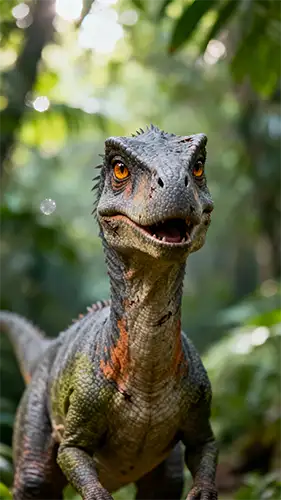
Use the uploaded reference image as the exact source for the protagonist’s identity and the overall visual language.
Preserve the existing character exactly as designed: the same stylized white feathered dinosaur, face, orange eyes, pink facial markings, narrow snout, feather shapes, body proportions, colors and scale.
Match the reference image’s rendering style, texture treatment and stylized realism. Animate the existing character; do not redesign, photorealize or reinterpret it.
PERSONALITY AND PERFORMANCE
The protagonist is clever, mischievous and quietly self-confident. It treats constant prehistoric danger as a normal inconvenience.
Its humor is dry and understated. It occasionally acknowledges the camera with a knowing glance. After chirping, it looks subtly proud of itself rather than embarrassed.
SCENE 1 — MORNING ROUTINE — 0.0–3.0
The small dinosaur wakes beside a simple nest on the damp forest floor. It raises its head, stretches naturally and looks toward the documentary camera.
In a relaxed, conversational voice, it says:
“So, this is my life. Wake up.”
SCENE 2 — DAILY SURVIVAL — 3.0–6.0
The protagonist walks briskly along a misty prehistoric forest path.
Carl, a much larger dark predatory dinosaur, suddenly runs across the distant background while searching in the wrong direction. He never approaches or touches the protagonist.
The small dinosaur notices him but remains completely calm. Without stopping, it glances toward the camera and says:
“Don’t get eaten.”
The joke comes from how casually it treats the danger.
SCENE 3 — THE ROAR MYTH — 6.0–11.5
Cut to a stable documentary-style medium close-up.
The protagonist faces the camera and says:
“Everyone thinks we roar. Me? I chirp.”
It produces one tiny, unexpectedly cute birdlike chirp.
After chirping, it gives the camera a pleased, slightly smug sideways glance.
In the distant background, Carl attempts an overly dramatic roar. His roar loses confidence halfway through and ends awkwardly.
The protagonist subtly gestures toward Carl and says:
“That’s Carl. Very insecure.”
Leave a brief comic pause between “Carl” and “Very insecure.”
SCENE 4 — THE MISSING EGG — 11.5–15.0
The protagonist returns to its nest and looks inside. The nest is empty.
It calmly lifts one nearby leaf, finds nothing, then slowly looks into the camera with a suspicious, mischievous expression.
It says:
“Still can’t find that egg.”
Hold on the deadpan expression for the final comic beat.
DIALOGUE AND AUDIO
Use the exact dialogue provided, with no additional narration or words.
The protagonist has one consistent voice throughout: conversational, dry, lightly amused and never rushed.
Keep the mouth and throat animation subtle and appropriate to the character’s anatomy. Do not give it human lips or exaggerated mouth movements.
Carl does not speak. He only produces one distant, insecure failed roar.
Use restrained forest ambience, soft footsteps, the protagonist’s tiny chirp and Carl’s distant roar. Keep the dialogue clear.
MOTION AND CONTINUITY
Use natural real-time pacing. Movements feel light and birdlike but remain grounded, with clear foot contact and believable weight.
Keep the protagonist’s face, body proportions, feather pattern and scale stable throughout.
Carl remains physically separated in the distant background. Preserve a clear and believable size relationship between the small protagonist and the much larger predator.
Use restrained mockumentary camera language. Prioritize readable performance and comic timing over fast action.
Avoid character morphing, sliding feet, unstable anatomy, frantic movement, physical collisions, exaggerated cartoon acting, subtitles and on-screen text.